Executive Summary
- Who this is for: CTOs, Engineering Leaders, Enterprise Architects, Product Leaders
- Problem it solves: Technical debt accumulates faster than organizations can schedule dedicated refactoring projects
- Key outcome: A structured model to reduce technical debt incrementally during feature delivery
- Time to implement: 30–60 days to institutionalize the practice
- Business impact: Continuous architecture improvement without halting product delivery
The Technical Debt Trap
Every engineering organization recognizes technical debt.
Teams say:
“We should refactor this.”
“This module needs redesign.”
“We need to clean up the architecture.”
But deadlines arrive.
Product features take priority.
Refactoring is postponed.
Months later:
- Systems become harder to change
- Development velocity slows
- Incident risk increases
- Engineers grow frustrated
Eventually leadership proposes a large modernization initiative.
These initiatives are expensive.
They disrupt delivery.
And in many cases, they fail.
The problem is not that organizations ignore technical debt.
The problem is how they try to fix it.
The Wrong Model: Separate Debt from Delivery
Many organizations treat technical debt as a separate activity.
Feature Development → Product backlog
Technical Debt → Refactoring backlog
This separation creates a structural problem.
Product features always win.
Debt accumulates faster than it is removed.
Eventually the system reaches a point where small changes become expensive.
At that stage the organization is forced into:
- major rewrites
- migration programs
- platform rebuilds
All because technical debt was isolated instead of integrated into development.
The Better Model: Feature-Driven Debt Reduction
The most sustainable approach is different.
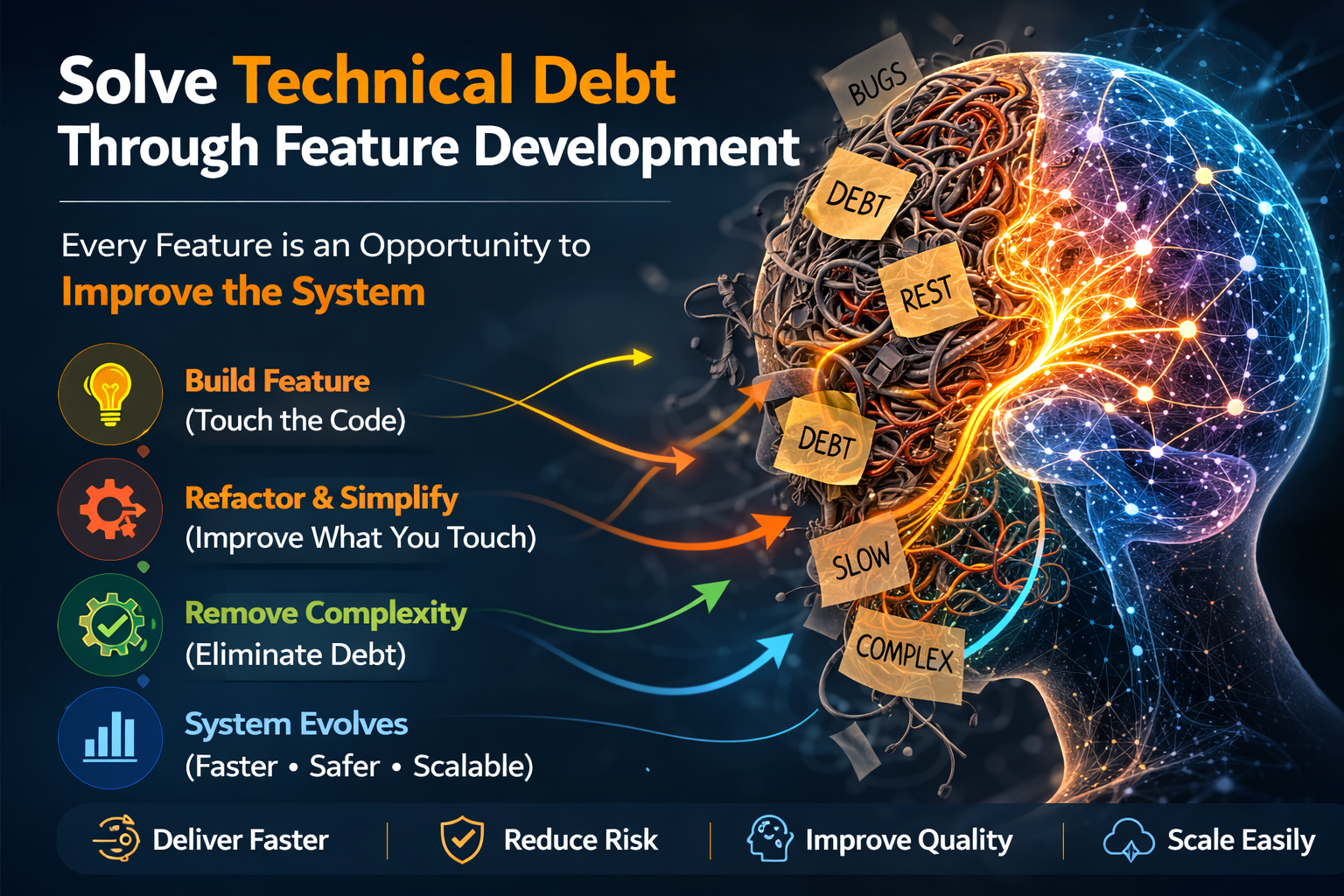
Technical debt should be addressed while building new features.
Every feature touches the system.
Every change is an opportunity to improve architecture.
Instead of separating the two, combine them.
Feature development becomes a vehicle for continuous architectural improvement.
The Feature Refactoring Principle
Whenever a team modifies a component, they should ask:
Can we leave this part of the system better than we found it?
This idea is sometimes called the Boy Scout Rule in software engineering.
But at organizational scale, it requires structure.
Three practices make it work.
The Feature-Driven Debt Reduction Model
When implementing a feature:
- improve the module being modified
- simplify complexity in that component
- remove obsolete code paths
- introduce better patterns
Do not attempt to fix the entire system.
Focus only on the area already being changed.
This keeps improvements incremental and safe.
2. Expand the Change Boundary Slightly
Feature delivery often reveals structural weaknesses.
Examples:
- tightly coupled modules
- missing service boundaries
- duplicated logic
- fragile integrations
Teams should be encouraged to extend the change slightly beyond the immediate feature to fix structural problems.
Small architectural corrections compound over time.
3. Capture Structural Improvements Explicitly
Architecture improvements should not be invisible.
When a team improves structure, document it through:
- pull request descriptions
- architecture notes
- Architectural Decision Records (ADR)
This ensures improvements become organizational knowledge, not isolated refactoring. :contentReference[oaicite:1]{index=1}
Why This Model Works
This approach succeeds for three reasons.
1. It Aligns with Product Incentives
Feature development always receives priority.
By embedding debt reduction within feature work, architecture improvement becomes part of delivery rather than competition with it.
2. It Prevents Massive Refactoring Projects
Instead of periodic “big cleanup initiatives,” the system evolves continuously.
This avoids risky, large-scale modernization programs.
3. It Keeps Architecture Evolution Continuous
Architecture is not static.
It must evolve alongside product capabilities.
Incremental improvement ensures the system remains adaptable.
Example
Imagine a team implementing a new order management feature.
Traditional Approach
The team:
- adds the new feature
- leaves existing complexity untouched
Result:
- the feature works
- the system becomes more complex
Feature-Driven Debt Reduction
The team:
- adds the feature
- extracts a shared service
- removes duplicate logic
- clarifies module boundaries
Result:
- the feature works
- the architecture improves
Delivery and improvement happen simultaneously.
Implementation Guide (60 Days)
Introducing this practice requires cultural alignment more than technical change.
Phase 1: Policy Alignment (Weeks 1–2)
Establish a simple rule:
Any feature touching complex or fragile code should include structural improvement.
Communicate this expectation across engineering teams.
Success Metric:
Refactoring becomes an expected part of feature delivery.
Phase 2: Architecture Visibility (Weeks 3–6)
Encourage teams to document improvements:
- ADRs for architectural changes
- clear commit descriptions
- architecture review for larger improvements
Success Metric:
Architecture evolution becomes visible and traceable.
Phase 3: Governance Integration (Weeks 7–8)
Align architecture review with feature development.
Architecture review boards should ask:
- Did this feature simplify or increase complexity?
- Were structural improvements identified?
Success Metric:
Architecture quality becomes part of delivery evaluation.
Evidence from Practice
Organizations that separate technical debt from delivery experience:
- growing refactoring backlogs
- large modernization initiatives
- declining engineering velocity
Organizations that integrate debt reduction into feature development experience:
- continuous architecture improvement
- fewer large-scale rewrites
- more maintainable systems
- higher engineering productivity
Architecture evolves gradually rather than collapsing under accumulated debt.
Action Plan
This Week
Ask three questions:
- How much technical debt exists in your backlog?
- How often do teams fix debt while implementing features?
- Do architecture reviews reward structural improvement?
If feature delivery always increases complexity, technical debt will eventually dominate development.
Next 30 Days
Introduce a simple rule:
Every feature touching complex areas should improve them.
Encourage teams to document structural improvements.
3–6 Months
Integrate technical debt reduction into:
- architecture reviews
- engineering performance metrics
- engineering design discussions
Over time, feature delivery becomes the engine of architecture evolution.
Final Thought
Technical debt is not removed through occasional cleanup projects.
It is removed through continuous architectural improvement.
Feature delivery touches the system every day.
That is where architecture evolves.
Organizations that wait for dedicated refactoring initiatives accumulate debt.
Organizations that improve structure during feature work evolve continuously.
The goal is simple:
Every feature should leave the system better than it was before.
Turn Feature Delivery into Continuous Architecture Improvement
If technical debt keeps appearing in your backlog…
if refactoring projects disrupt product delivery…
or if system complexity is increasing faster than teams can manage —
your development model may be separating delivery from architecture evolution.
In a focused 30-minute Architecture Sustainability Diagnostic, we will:
- Evaluate how technical debt accumulates in your systems
- Identify structural bottlenecks slowing feature delivery
- Introduce a practical model for feature-driven architecture improvement
- Define governance practices that sustain long-term architectural health
No massive rewrite programs.
No endless refactoring backlogs.
No architecture theater.
Just a delivery model where every feature improves the system.
→ Book an Architecture Sustainability Session
or
Architecture improves best when evolution becomes part of everyday delivery.